How can you check your VAT return?
You’ve just received your draft VAT return from Accountability Edinburgh. We’ve already reviewed your sales and purchase data to ensure accuracy. But because we require authorisation to submit your return, it’s helpful to understand what you’re looking at so you can confidently confirm everything is correct.
Types of VAT Returns
Different VAT schemes produce different types of returns. The standard (accrual) return calculates VAT based on invoice dates, while the cash accounting scheme calculates VAT based on when invoices and bills are paid.
Some businesses use more specialised schemes. Partial exemption applies if you sell both VAT‑able and exempt goods or services. The flat‑rate scheme applies a fixed percentage to your turnover, and the retail scheme offers a simplified method for certain high‑volume industries. Your account manager will ensure you’re on the most suitable scheme.
Boxes and Boxes and Boxes
The key figures on your VAT return appear in Box 1 and Box 4. Box 1 shows VAT owed to HMRC; Box 4 shows VAT you can reclaim. Boxes 6 and 7 restate the net values behind those figures. These should broadly match what you expect based on your sales and purchases for the period.
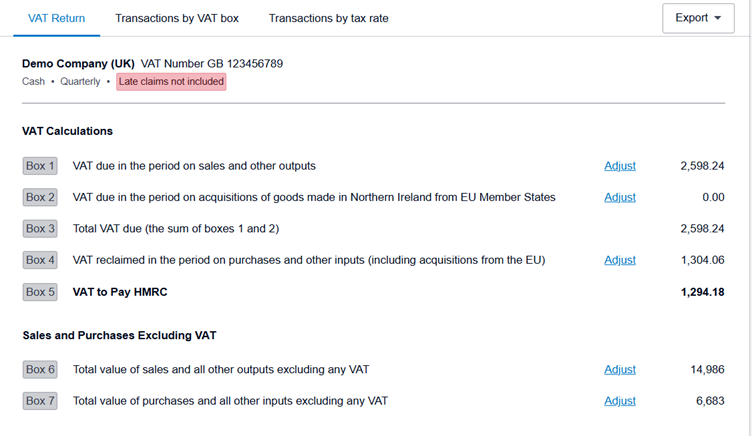
Example from Xero demo account, no client figures were used
Sales (Box 1)
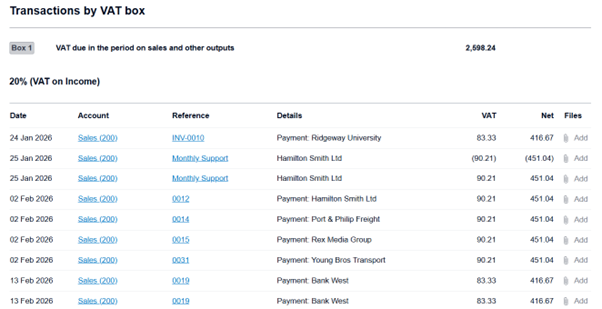
Box 1 reflects VAT due on your sales.
Think about what you sell and whether your products or services are standard‑rated, reduced‑rated, zero‑rated, or exempt. If you’re unsure, your account manager can clarify the correct VAT treatment.
Consider where your customers are based. If the place of supply is the UK, VAT normally applies, regardless of whether the customer is VAT‑registered. Overseas customers are often outside the scope of UK VAT, but check if you’re uncertain.
Finally, look at whether the total sales figure feels reasonable compared with your expectations.
Purchases (Box 4)
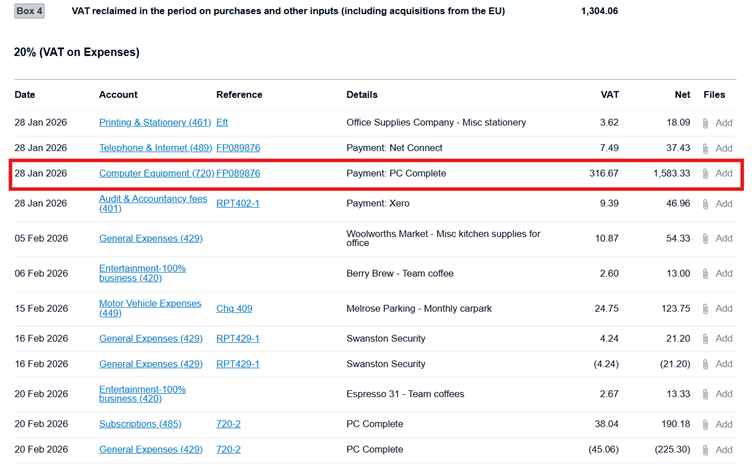
Box 4 shows the VAT you can reclaim.
If you made any large purchases, check that these appear on the VAT return.
If you import goods, look for Import VAT. You can reclaim this with a C79 certificate, available through your Government Gateway account. If you import regularly, your account manager may recommend Postponed VAT Accounting.
Bottom Line (Box 5)
Box 5 shows the final amount payable to HMRC or reclaimable by you. If Box 1 is higher than Box 4, you owe HMRC; if Box 4 is higher, HMRC owes you. Xero clearly labels this as “VAT to Pay HMRC” or “VAT to Reclaim from HMRC,” making it easy to understand your position.
FAQs
When is my next VAT return?
Check your government gateway account (insert login link): - VAT – Upcoming Returns
Check Xero (insert login link): – Tax – VAT Returns
Keep in mind that VAT returns can be quarterly, monthly or annually.
When do I need to file my VAT return?
One month and 7 days after the period end. So if the period end is 31 March, then the VAT return will be due on 7th May.
When do I need to pay my VAT bill?
If you are on direct debit, it will automatically be taken from your bank account on or around the 10th, after the due date.
If you have to pay it yourself, you must pay on or before the 7th – on the due date.
When will I get my refund??
Most refunds are paid out right away, and the latest you should expect to be paid is 7 working days after the VAT deadline. Sometimes there are HMRC queries which may result in delays. Your account manager will assist with any VAT queries from HMRC.
What happens if I file my VAT return late?
If you file a VAT return late, you get “points” on your account. Too many points and HMRC will send you a penalty of £200 and an additional £200 for each late return after that. Points can be erased if you file your VAT returns on time.
Useful links:
https://www.gov.uk/guidance/penalty-points-and-penalties-if-you-submit-your-vat-return-late
What if I can’t afford to pay my VAT bill?
You need to set up what is called a “Time to Pay” agreement with HMRC. This gives you the chance to spread out your VAT bill over several months. You can do this online or over the phone.
If you do not follow through on your Time to Pay agreement, HMRC will act as if it never existed in the first place (see below).
Only you can set up a Time to Pay agreement; Accountability Edinburgh cannot do this for you.
Useful link: https://www.gov.uk/difficulties-paying-hmrc
What happens if I pay my VAT bill late?
HMRC will charge interest from the first day that the VAT payment was due.
Penalties will be added as a percentage of what is owed. The more days late, the higher the rate of penalty. These can quickly add up in the space of a month, so if you can’t pay your VAT bill you should contact HMRC immediately.
You can avoid late payments by signing up to direct debit for VAT.
Useful links:
https://www.gov.uk/guidance/how-late-payment-penalties-work-if-you-pay-vat-late
https://www.gov.uk/pay-vat/direct-debit
How can we help?
If you’re unsure whether your VAT return looks right, don’t fully understand the figures, or feel like you’re being asked to sign it off without explanation – you’re not alone.
At Accountability Edinburgh, we believe you should understand your numbers – not just approve them. Your account manager is always happy to talk you through your VAT return, explain what’s driving the figures, and answer any questions before submission.
If you’re not a current client of ours – and you’re not getting this level of support from your accountant, or if you’d like a more hands-on, jargon-free approach to VAT – get in touch. We’d be happy to help.